 Mathematics Magazine
 Advertise Here. E-mail us your request for an advertising quote!
| Mathematics Magazine |
||||
| Home | Articles | Math Book | Applications | Contact Us |
|
Advertise Here. E-mail us your request for an advertising quote!
|
||||
|
Mathematics in Babylon - The reciprocals of regular numbers The Technique is a
procedure for finding the reciprocals of regular numbers. A
regular number is one which can be expressed as a multiple of 2, 3,
and 5 only, and so has a finite sexagesimal reciprocal. Old
Babylonian scribes went to a lot of trouble in school texts to make
sure that students only had to find reciprocals of regular numbers.
Indeed, most of the time, students were just expected to find
reciprocals that were in the standard table (this gave reciprocals of
regular numbers between 2
and 1,21
= 81). For finding the
reciprocals of regular numbers not in the table, the students used a
standard procedure, first explained by A. Sachs and called The
Technique. Here we briefly describe the algorithm and give some
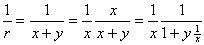
examples. For the convenience of the modern reader, we give an utterly ahistorical justification of the Technique in modern algebraic terms. The basic idea is to write the reciprocal of r as a product of two terms, one of which we already know because it is in the table. In order to do this, we first write r as a sum r = x + y, where x is a number from the standard reciprocal table. Then we notice that
Because x was
in the standard reciprocal table, we know 1/x, and we are left
to find the reciprocal of (1+y(1/x)), which is hopefully
simpler. If it is in the table, we are done, otherwise we repeat
the process. Let us go through a
simple example, using the favorite Old Babylonian number 2,5 (= 125). This number is
called the igum. Its reciprocal, which we want to find,
is called the igibum. According to the technique, we want
to write 2,5 as
the sum of two numbers, one of them from the standard table. The
Babylonians 'broke off' the largest number that was in the table, in
this case 5. The reciprocal of 5 is 12. Multiply 12
into (the remaining) 2
to get 24.
Add 1,
you will see 25.
The reciprocal of 25
is 2,24. Multiply 2,24 by 12.
You will see 28,48.
The igibum is 28,48. As a step-by-step procedure, we proceed as
follows: Step 1: Break off the largest number in the standard reciprocal table. (5) Step 2: Find its reciprocal. (12) Step 3: Multiply this number by the remainder of the original number. (12 times 2 is 24) Step 4: Add 1. (1 plus 24 is 25 ) Step 5: Find the reciprocal of this number (repeat steps 1 to 4 if necessary) (reciprocal of 25 is 2,24) Step 6: Multiply the original reciprocal by this one. (2,24 times 12 is 28,48) The Technique is
well-described in the tablet VAT 6505, published by Neugebauer in MKT
1, 270ff. The tablet is somewhat broken and not all the problems
can be restored. Here are the numbers from two of the problems,
written in cuneiform so it is easy to see the 'breaking off':
|
|---|
"Chance favors the prepared mind." - Louis Pasteur |
 .
.
 has the


 has the
